
Stop Being "Nice" in Business: Why People-Pleasing Is Costing You Clients (And Your Sanity)
Jan 28
/
Kerstin Oleta, CEO and Founder of the Business Leadership Excellence Institute (BLEI)
Let's talk about something uncomfortable...but that will finally get you some results.
You pride yourself on being professional, accommodating, and easy to work with.
You adjust your approach to make prospects comfortable. You soften your language so you don't seem "too much." You wait to see what others need before you state what you offer. You apologize before setting boundaries.
You're being nice.
And it's killing your business.
Here's what no one tells you: "Nice" isn't kind. It's passive-aggressive. And your ideal clients can feel it—even if they can't name it.
Here's what no one tells you: "Nice" isn't kind. It's passive-aggressive. And your ideal clients can feel it—even if they can't name it.
That's why they say "let me think about it" when you know you're the perfect fit. That's why they lean back during discovery calls. That's why your expertise gets overlooked while less qualified competitors get hired.
It's not your skills. It's your presence.
And specifically, the fact that you've been trained your entire life to be something that directly contradicts business success.
The Socialization Trap: How We Learn to Be "Nice"
If you're a woman in business, coaching, or consulting, you've probably been socialized since childhood to:
- Make others comfortable first
- Don't be "too much" or "too assertive"
- Adjust your boundaries to accommodate
- Wait your turn to speak
- Downplay your expertise so others don't feel threatened
- Smooth over tension at all costs
- Put everyone else's needs before stating your own
This was great training for being liked. It's terrible training for being respected.
And in business, respect matters more than being liked.
A recent client—a brilliant physician-turned-coach—exemplifies this perfectly. She came to me because despite being the most qualified person in her field, she kept losing prospects to less experienced coaches.
When I watched her discovery calls, I immediately saw the problem.
She was being nice.
"What would work best for you?" she'd ask.
"I'm flexible with my approach," she'd say.
"Does that make sense?" she'd question after every point.
"I'm sorry, but I do need to mention pricing..." she'd apologize.
Translation to the prospect's primal brain:
"She's not sure of herself. She's adjusting to me. She needs my approval. Should I really trust her with my biggest problem?"
Her expertise was never in question. Her presence was.
What "Nice" Actually Communicates
You think being nice shows:
- You're easy to work with
- You're empathetic
- You're professional
- You care about their comfort
What it actually signals:
1. Lack of Confidence
If you're constantly adjusting to make others comfortable, they unconsciously wonder: "If she's so confident in her expertise, why does she keep changing her approach?"
2. Unclear Boundaries
When you're "flexible" about everything, clients don't know what to expect. Uncertainty triggers the primal brain's safety mechanism—and the default answer is NO.
3. Permission to Question
Every "Does that make sense?" invites them to doubt you. Every "I'm sorry, but..." undermines your authority before you even state your position.
4. Unequal Partnership
You're positioning yourself as adjusting to them, rather than being in equal partnership. This creates an unconscious power dynamic where they're evaluating you instead of collaborating with you.
The "Nice" Phrases That Are Sabotaging You
Listen to yourself in your next three client conversations. Count how many times you say:
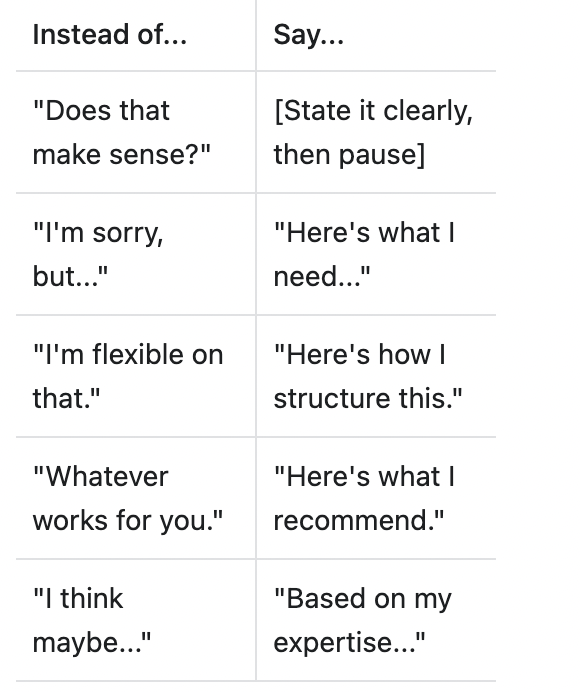
"Does that make sense?"
Translation: "I'm not sure if I explained that well. Please validate me."
Better: State it clearly, then pause. Let silence do the work.
"I'm sorry, but..."
Translation: "I'm apologizing for having needs/boundaries/requirements."
Better: "Here's what I need..." or "Here's how this works..."
"I'm flexible on that"
Translation: "I don't have clear boundaries. You can push me."
Better: "Here's my process" or "This is how I structure it"
"Whatever works best for you"
Translation: "I don't have a clear lane. I'll adjust to anything."
Better: "Here's what I recommend based on your needs"
"I think maybe..."
Translation: "I'm not confident in this recommendation."
Better: "Based on what you've shared, here's what I recommend..."
"What would you like me to do?"
Translation: "You lead. I'll follow."
Better: "Here's the path forward I'm proposing..."
See the pattern? "Nice" language consistently positions you as reactive, uncertain, and seeking approval.
Clear language positions you as confident, boundaried, and leading with expertise.
The Two Types of "Nice" (And Why Both Fail)
Type 1: The Accommodator
You adjust everything to fit their preferences:
"I can work with any schedule."
"My process is flexible based on what you need."
"I'm open to however you want to structure this."
What happens: They respect you less because you have no clear methodology. If you don't have a strong process, why should they trust you with their problem?
Type 2: The Question-Asker
You constantly seek validation:
"Does that resonate?"
"Do you see what I mean?"
"Am I explaining this clearly?"
What happens: You're inviting them to doubt you. Each question creates a moment where they evaluate rather than engage.
The Alternative: The Clear Leader
You state your expertise proactively:
"Here's my process and why it works."
"Based on what you've shared, here's what I recommend."
"This is how we'll structure our work together."
What happens: They lean in. They trust you. They say yes faster.
The Real Cost of Being "Nice"
Let's talk numbers.
1. Time
2. Energy
Constantly adjusting to others is exhausting. You're people-pleasing instead of leading.
3. Money
4. Confidence
5. Ideal Clients
That physician-turned-coach I mentioned? When she was being "nice," her close rate was about 30%. She'd have 10 discovery calls and convert 3 clients.
After shifting from nice to clear: Her close rate jumped to 90%. Same expertise. Same offer. Different presence.
But it's not just about conversion rates. Being "nice" costs you:
1. Time
You spend hours on discovery calls that go nowhere because you never established clear boundaries upfront.
2. Energy
Constantly adjusting to others is exhausting. You're people-pleasing instead of leading.
3. Money
Lower close rates mean you need 3x the leads to hit the same revenue.
4. Confidence
Every "let me think about it" chips away at your self-trust. You start questioning your expertise when the real issue is your presence.
5. Ideal Clients
Your dream clients are looking for confident leadership. "Nice" signals uncertainty, so they choose someone else.
The Permission You've Been Waiting For
I'm going to say something that might feel uncomfortable:
You don't need to be nice. You need to be clear.
And clear isn't mean. It's not cold. It's not aggressive. Clear is:
Clear is actually kinder than nice.
Because when you're clear:
When you're nice:
Which actually serves your clients better?
You don't need to be nice. You need to be clear.
And clear isn't mean. It's not cold. It's not aggressive. Clear is:
- Stating your expertise without apologizing
- Setting boundaries proactively
- Leading with your full authority
- Creating invitation without seeking permission
- Being direct about your process and pricing
- Maintaining consistent presence regardless of others' reactions
Clear is actually kinder than nice.
Because when you're clear:
- Ideal clients immediately know if you're the right fit
- Poor-fit clients don't waste their time (or yours)
- Everyone knows exactly what to expect
- You can deliver your best work within defined boundaries
- Your confidence allows them to trust you fully
When you're nice:
- Everyone is confused about whether you're the right fit
- You attract people who want to push boundaries
- Expectations are constantly shifting
- You burn out trying to be everything to everyone
- Your lack of clarity makes them uncertain
Which actually serves your clients better?
The Shift: From Nice to Clear
Here's exactly how to make this transformation:
Step 1: Identify Your "Nice" Patterns
For one week, track every time you:
Step 2: Create Your Clear Alternatives
Step 1: Identify Your "Nice" Patterns
For one week, track every time you:
- Say "I'm sorry" when you're not actually apologizing
- Ask "Does that make sense?" or similar validation questions
- State you're "flexible" on boundaries
- Adjust your approach mid-conversation to accommodate
- Downplay your expertise or credentials
- Wait to see what they want before stating what you recommend
Step 2: Create Your Clear Alternatives
Write out your new default language:
Step 3: Practice Your Lane
- Write a 30-second statement that clearly defines:
- Who you serve
- What do you specialize in
- Your unique approach
- What's outside your scope
- Practice saying it out loud until it feels natural and confident.
Step 4: Set Proactive Boundaries
Before your next client interaction, decide:
- What are your non-negotiables?
- What's your process?
- What won't you adjust?
- What do you need to be successful?
- State these upfront, not apologetically.
Step 5: Notice the Discomfort (And Push Through)
When you first stop being nice and start being clear, you'll feel uncomfortable. That's your socialization talking. You might worry:
- "Am I being too harsh?"
- "Will they think I'm difficult?"
- "Should I be more accommodating?"
Here's the truth: If someone needs you to be "nice"(READ: Vague and Accommodating) to work with you, they're not your ideal client. Your ideal clients are looking for someone confident enough to lead them.
What Clear Leadership Actually Looks Like
Let me paint you a picture of what changes when you shift from nice to clear:
Scenario: Discovery Call
Nice Version:
"So, um, I have a few different ways I work with clients. I'm pretty flexible with my approach. What would work best for you? I mean, I can adjust based on what you need. Does that make sense? I'm sorry, I should probably explain my pricing, but we can talk about that later if you want..."
Clear Version:
"Based on what you've shared, here's what I recommend: [specific program]. Here's why this approach works for your situation: [clear explanation]. We'd work together for [timeframe], and the investment is [price]. I have space for two new clients this month. What questions do you have?"
See the difference?
The nice version leaves the prospect doing all the evaluating. They have to decide what they need, how they'd work together, and whether to ask about pricing.
The clear version leads them. You've established your expertise, made a specific recommendation, stated the structure and investment, and invited questions.
Which prospect is more likely to say yes?
The one who's being led with clarity.
The Client Who Changed Everything
I'll never forget the message I got from a client six weeks into working together:
"I just closed the biggest contract of my career—$45K. And here's the wild part: I said NO three times during the sales conversation. I stated my boundaries. I didn't adjust my process to fit their requests. I was clear instead of nice. And they said 'That's exactly why we want to work with you. We need someone who knows what they're doing and isn't afraid to say it.'
"I would have lost this deal six weeks ago by being 'nice.' I would have adjusted, apologized, and talked myself out of the sale by trying too hard to make them comfortable."
This is the power of being clear.
The right clients don't need you to be nice. They need you to be certain.
They need you to know your process so well that you don't adjust it.
They need you to value your expertise so highly that you don't apologize for it.
They need you to maintain your boundaries so clearly that they trust you'll do the same when working with them.
"Nice" doesn't inspire confidence. Clear does.
Your 5-Day Challenge: Replace Nice with Clear
Want to experience this shift immediately? Here's your challenge:
1. Track Your "Nice"
Count every validation question, apology, and "flexible" statement. Just awareness—no judgment.
2. Write Your Clear Statements
Create alternatives for your top 5 "nice" phrases using the framework above.
3. Practice Your Lane
Record yourself stating your expertise, process, and boundaries clearly in 30 seconds.
4. Set One Boundary
Choose one interaction and state a boundary proactively without apologizing.
5. Lead One Conversation
In one full conversation, lead with clarity instead of adjusting to make them comfortable.
Track what happens.
Track what happens.
I'd bet money you'll see:
- People leaning in more
- Fewer questions about your qualifications
- More "yes" decisions
- Greater respect in interactions
- Less energy drain
The Uncomfortable Truth About Being Clear
Here's what I need you to understand:
Some people won't like it when you stop being nice.
The people who benefited from your lack of boundaries will push back.
The people who liked that you adjusted to them will be uncomfortable.
The people who enjoyed your constant validation-seeking will wonder what changed.
Let them.
Because for every person who misses your "nice" version, there are ten ideal clients who are desperately looking for someone who's clear.
Your people don't need you to be nice. They need you to:
Know what you're doing
State it confidently
Hold clear boundaries
Lead them to their transformation
And you can't do any of that while being "nice."
And you can't do any of that while being "nice."
The Body Language Connection
Here's something fascinating: Your words might say one thing, but your body language reveals the truth.
When you say "I'm flexible" while your shoulders are slightly hunched and your voice goes up at the end (unconsciously seeking approval), your prospect's primal brain registers: "She's uncertain."
When you say "Here's my recommendation" while maintaining eye contact, keeping your shoulders back, and using a level tone, their primal brain registers: "She's confident. I can trust her."
When you say "I'm flexible" while your shoulders are slightly hunched and your voice goes up at the end (unconsciously seeking approval), your prospect's primal brain registers: "She's uncertain."
When you say "Here's my recommendation" while maintaining eye contact, keeping your shoulders back, and using a level tone, their primal brain registers: "She's confident. I can trust her."
This is why stopping being "nice" isn't just about changing your words—it's about transforming your entire presence.
You need:
- Clear language (words that lead, not seek approval)
- Clear boundaries (stated proactively, not apologetically)
- Clear body language (consistent regardless of their reactions)
- Clear energy (maintaining your lane no matter what they do)
This is Body Language Strategy.
Not tips and tricks about where to put your hands or how to stand. But a complete system for creating proactive presence that attracts ideal clients and naturally vets out poor fits.
Ready to Stop Being "Nice" and Start Being Magnetic?
If you're exhausted from:
- Adjusting your approach for every prospect
- Constantly seeking validation
- Losing deals you know you should win
- Attracting clients who push your boundaries
- Feeling drained after every sales conversation
It's time to learn Body Language Strategy.
I've created a complete 5-session micro course that takes you from "nice" people-pleaser to clear magnetic leader.
What You'll Learn:
Session 1: The Paradigm Shift
Session 2: The Two Universal Resistances
Session 3: Creating Your Lane
Session 4: The Greater Self Exercise
Session 5: Proactive Presence in Practice
Plus Bonus Resources:
From reactive nice to proactive clear—understanding why your current approach is costing you clients
Session 2: The Two Universal Resistances
What's really driving client hesitation (and how to prevent it with your presence)
Session 3: Creating Your Lane
How to establish clear boundaries that magnetize ideal clients and repel poor fits
Session 4: The Greater Self Exercise
Building the detailed vision that transforms how you show up every single day
Session 5: Proactive Presence in Practice
Integration framework for maintaining clarity in every interaction
Plus Bonus Resources:
- Quick reference checklist for every client interaction
- Tracking templates to measure your transformation
- 30-day practice plan with specific weekly focuses
- Key distinctions reference guide
This isn't theory. This is the exact system I've used with executives at Google, Amazon, and eBay Global.
The same methodology that helped that physician-turned-coach triple her close rate.
The same framework that's allowing leaders to close $45K contracts by saying NO instead of adjusting.
Here's what changes when you complete this micro course:
✓ You enter every conversation with clear intention instead of nervous accommodation
✓ You state your expertise confidently without seeking validation
✓ You set boundaries proactively instead of apologetically
✓ You lead conversations instead of reacting to them
✓ You attract ideal clients who respect your authority
✓ You naturally repel poor-fit clients who want to push boundaries
✓ You close more deals while working with better clients
And most importantly, you stop exhausting yourself trying to be nice and start experiencing the success that matches your expertise.
And most importantly, you stop exhausting yourself trying to be nice and start experiencing the success that matches your expertise.
Your Invitation (Not a Sales Pitch)
I'm not going to use persuasive language or create false urgency.
Investment: $49
No tricks. No manipulation. Just a clear path from where you are to where you want to be.
Here's what's true:
If you keep being "nice," you'll keep getting the same results.
If you're ready to be clear, confident, and magnetic instead, this micro course will show you exactly how.
It's not about becoming someone you're not.
It's about finally showing up as who you actually are—an expert with valuable expertise who deserves respect, boundaries, and ideal clients.
STAY TUNED & ENROLL IN THE NEW
BODY LANGUAGE STRATEGY MICRO COURSE!
BODY LANGUAGE STRATEGY MICRO COURSE!
Investment: $49
Format: 5 self-paced sessions with implementation homework
Bonus: Templates, checklists, and 30-day practice plan
Guarantee: If you complete all 5 sessions and don't see a measurable shift in how clients respond to you, I'll refund 100%
No tricks. No manipulation. Just a clear path from where you are to where you want to be.
Final Thought: The Permission You're Waiting For
A client once told me:
"I was waiting for someone to give me permission to stop being nice. You did. And it changed everything."
Consider this your permission.
You don't need to be nice. You need to be clear.
You don't need to accommodate everyone. You need to serve your ideal clients excellently.
You don't need to apologize for your expertise. You need to lead with it confidently.
You don't need to adjust to everyone else's comfort. You need to establish your own lane.
The right clients are looking for someone clear, not someone nice. Are you ready to be that person?
The right clients are looking for someone clear, not someone nice. Are you ready to be that person?
START YOUR TRANSFORMATION! ENROLL NOW
Remember: Being clear isn't mean. It's kind. It's professional. It's what your expertise deserves and what your ideal clients need.
About the Author
With 30+ years as a professional opera singer and extensive training in neuroscience-based communication, I've spent my career understanding how presence creates trust, credibility, and influence at a primal level. I've trained executives at Fortune 500 companies and watched countless professionals transform their businesses by shifting from nice to clear. Body Language Strategy is the methodology that makes it systematic and repeatable.
Ready to stop being “nice” and start being taken seriously? Let’s talk about the presence that’s costing you clients—and how to fix it. Contact BLEI for Body Language Strategy training designed for leaders who are done shrinking and ready to lead with authority.
Contact Kerstin Here:
https://www.bleinstitute.com/about
https://www.bleinstitute.com/about
Subscribe to our newsletter
Thank you!
Policy Pages
Write your awesome label here.
Subscribe to our Newsletter
Thank you!